

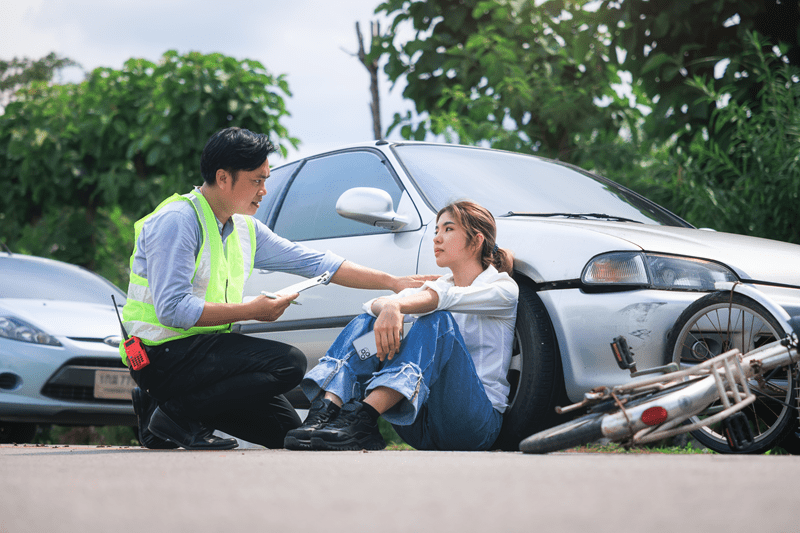
Bicycles are everywhere in the U.S., Morning commuters weaving through traffic. Weekend riders chasing quiet roads. Kids pedaling through neighborhoods just before dinner. And yet, when a car and a bicycle collide, confusion usually follows right behind the shock. Who pays for what? Which insurance steps in? And does auto insurance bicycle accident coverage actually help, or is that just insurance jargon that sounds better than it works?
This guide walks you through how auto insurance applies to bicycle accidents in the U.S., what coverage really means, and where the gaps tend to hide. We’ll talk about liability, uninsured drivers, medical bills, and those gray areas that don’t get enough attention.
Auto insurance and bicycles don’t seem like a natural pair. One has an engine and plates. The other has pedals and a bell. Still, when a car hits a cyclist, auto insurance often becomes the main player.
Before breaking down the details, it helps to know this: most bicycle accidents involving cars are handled through the driver’s auto insurance policy, not the cyclist’s.
Under most U.S. policies, cyclists are considered pedestrians. That’s a big deal. It means when a driver causes an accident, their liability coverage can apply to injuries and property damage involving a bike rider.
Medical bills, bike repairs, lost wages—these may all be covered if the driver is at fault. The catch, of course, is proving fault. And that’s where police reports, witnesses, and even dashcams start to matter more than you’d expect.
Insurance rules aren’t identical across the country. Fault-based states operate differently from no-fault states. In no-fault states, cyclists might rely first on personal injury protection, even though they weren’t driving.
Also read: Obtain the Best Deal and Compare Insurance Quotes Easily Now
This question comes up constantly, usually from shaken riders standing on the roadside. Does auto insurance cover bicycle accidents? The short answer is yes, often. The longer answer depends on fault, coverage limits, and policy type.
If a driver causes the crash, their liability coverage typically pays for the cyclist’s injuries and damages. This is the most straightforward scenario. Emergency care, follow-up treatment, bike replacement—these costs can be included.
That said, coverage isn’t unlimited. Policy limits matter. A serious injury can burn through a low-limit policy faster than anyone expects.
Life isn’t always clean-cut. Maybe the cyclist swerved. Maybe the driver rolled a stop sign. In shared fault cases, compensation may be reduced.
States follow either comparative or contributory negligence rules. Some allow partial recovery. Others are less forgiving. It’s frustrating, but it’s how the system works.

Every accident tells a slightly different story. And how car insurance bicycle accident claims play out often depends on the details no one notices at first.
This section looks at common situations cyclists face, sometimes without realizing how insurance responds.
A parked driver opens a door. A cyclist slams into it. That’s a classic scenario. In many cases, the driver’s auto liability still applies, even though the car wasn’t moving.
Intersections are another hot spot. Left turns, right hooks, failure to yield. These moments happen fast, and insurance companies review them slowly, frame by frame.
Here’s where emotions run high. The driver speeds off. Panic sets in. Now what?
This is when uninsured motorist bicycle accident coverage becomes incredibly valuable. If the cyclist has access to this coverage, often through their own auto policy or a household member’s policy, it may help cover injuries.
Auto insurance plays a major role, but it’s rarely the only piece. Bicycle accident insurance coverage can come from several directions, and they sometimes overlap in surprising ways.
Understanding these layers can reduce stress when the paperwork starts piling up.
Health insurance usually covers medical treatment regardless of fault. It’s often the first line of defense, especially in no-fault states.
Medical payments coverage, found in many auto policies, may also apply. It can help with immediate expenses like ER visits or physical therapy, without waiting for the fault to be resolved.
Here’s a curveball. If a cyclist causes damage to a vehicle or injures someone while riding, homeowners' or renters' insurance may step in. That’s not common knowledge, but it’s real.
Policies vary. Limits apply. Still, it’s worth knowing this safety net exists.
Liability sounds like a cold word. Legal. Distant. But after an accident, it becomes personal fast.
Bicycle accident liability insurance focuses on who caused the crash and who pays for the harm that followed.
Cyclists aren’t immune to mistakes. Running a light. Ignoring signage. Swerving unpredictably.
If a cyclist causes an accident, they may be held liable for damages. This is where personal liability coverage through homeowners or renters insurance can matter.
It’s uncomfortable to think about. But ignoring it doesn’t make it disappear.
Sometimes blame spreads around. A poorly marked bike lane. A distracted driver. A cyclist is riding too fast.
In these cases, insurance companies negotiate. Percentages get assigned. Payments adjust. It’s messy, but it’s how claims often resolve.
Don't miss: Insurance Deductibles Explained for Choosing the Right One
This section deserves extra attention, because it’s the quiet hero in many bicycle accident cases.
Uninsured motorist bicycle accident coverage protects cyclists when drivers have no insurance or not enough of it.
Many auto policies extend uninsured motorist coverage to the policyholder as a pedestrian or cyclist. That means if you’re hit while riding, your own policy may help.
You know what? People are often shocked by this. They assume coverage only works inside the car. It doesn’t.
Some drivers carry the bare minimum. When injuries are severe, that minimum barely scratches the surface.
Underinsured motorist coverage can fill the gap. It’s not flashy. But when it’s needed, it’s invaluable.
Auto insurance bicycle accident coverage isn’t mysterious once you see the moving parts. Liability, medical coverage, uninsured protection—they all work together, sometimes awkwardly, sometimes smoothly.
The biggest mistake cyclists make is assuming insurance won’t help them. The second biggest mistake is assuming it will handle everything automatically.
Yes. Cyclists are usually treated as pedestrians, so coverage often applies even when you weren’t in a car.
Often, yes. Many policies extend this protection to cyclists injured by uninsured drivers.
Liability may fall on the cyclist, and homeowners' or renters' insurance could apply.
Yes. Bike repair or replacement is often included under property damage coverage.
This content was created by AI